Showing posts with label Apple cider. Show all posts

Sunday, December 30, 2018

2018: Making Pear and Apple Cider

Last year we used a pedal-powered grape crusher to process fruit before pressing juice out but the coarse pulp did not release all the liquid. A few YouTube videos demonstrated how well an under sink garbage disposal unit pulverizes fruit and documented that over 85% of the liquid can be readily drained from the apple sauce consistency pulp. We purchased a 3/4 horsepower all stainless steel unit for under $100 and will use it exclusively for making cider. It makes the process much faster and 15 or 20 gallons can be readily done in an afternoon by one or two people.


The Gray Box Holds the Garbage Disposal Unit and Fruit, Pushed Through the Bowl, Comes Out as Applesauce into the Bowl on the Ground

View Showing the Hole in the Bowl Bottom
The Outdoor Cider Making Setup Showing Fruit Washing Station to the Press 
Filling the First Layer of Apple Pulp in the Press
Pressing the Five Layers of Pulp So the Juice Fills the White Tray and Out through a Hole and into the Blue Funnel and 5-Gallon Glass Carboy Below
Second Layer of Pulp Being Loaded into the Press with a Chicken Waiting for "Apple Cardboard", the Almost Dry Product Layers from the Press
Another Day with the Fifth Layer of Pear Pulp Being Loaded into the Press
The Umbrella Shields the Pulping Operation from the Sun
Another View of the Pressing Operation: Various Blocks Are Used to Extend the Stroke of the Hydraulic Press
Pear Crushing Operation with Chickens Gleaning Seeds Dropped
Four Carboys of Pear Cider for Fermenting with an Additional Pot for Fresh Juice


Fruit "Cardboard" Unwrapped from its Filter Cloth

Fruit Pulp "Cardboard"
Applesauce Consistency Pulp Is Contained in Fabric to Filter the Juice into the Tray Below. This Fabric Proved too Weak to Withstand the Pressure.


Sunday, July 31, 2016

Rainy Day: Perfect for Bottling Cider

We welcomed rain today: the first real rain we've received all summer. Today is the first day in the four months I've been logging rainfall that the gage recorded more than an inch! When that happens, the central tube fills to the top and lets the overflow bleed into the surrounding volume. Tomorrow morning I'll have to add this extra rain to 1.00 inches to obtain the total. 
Siphoning Dark Hoppy Cider Into a Bucket So Maple Syrup Can be Added Without Disturbing the Layer of Yeast on the Bottom of the Carboy
Decanting Clear Apple Cider That Has Fermented 10 Months
When it's pouring is a perfect time to bottle cider. I chose to siphon both a carboy of hard hoppy apple cider, that also had some brown sugar added to make it around 9% alcohol, and one of pure apple juice, now 6% still cider. I added 11 ounces of maple syrup to each four gallon batch to carbonate these drinks in their bottles. It will take a month or so for the yeast to convert the sugar in the syrup into the carbon dioxide that makes the bubbles.
Illustrating the Color of the Pure Apple Cider 
Basement Shelf Holds 35 Bottles of the Hoppy Cider (Left) and 37 Bottles of Plain Cider

Tuesday, January 19, 2016

Bottling Cider


With outdoor temperatures below 20F and a raw wind blowing was a good time to bottle cider in the kitchen, by the warm stove. I had two six-gallon pails of pear and apple ciders that began fermenting last September. By December their fermentation locks no longer bubbled: yeast had transformed juice sugars to alcohol and carbon dioxide (the bubbles). As long as air (oxygen) does not contact brewed liquids (by keeping the air lock filled with water), one can keep it for months and bottle it a month before running out of finished ciders. It takes four to six weeks for yeast to carbonate cider in bottles.

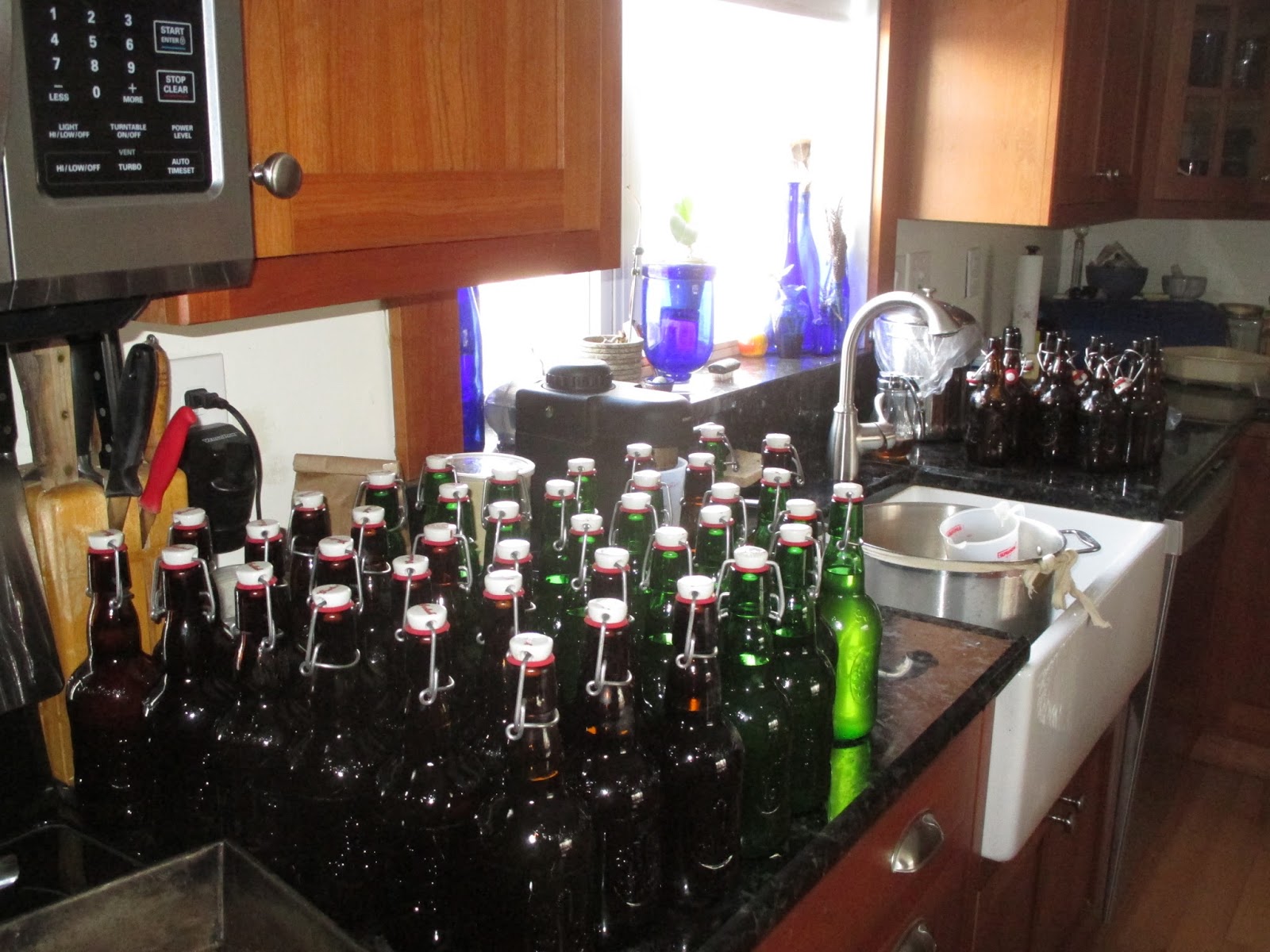
I had accumulated about 10 gallons worth of empty bottles so I began processing the first two cider vessels: 6+ gallons of "hot" apple cider and 6 gallons of pear cider. By not moving the tall pails while carefully removing tops, I was able to ladle off three gallons of clear cider from both without filtering. I added 12 ounces of maple syrup (for the yeast to transform into carbonation) to each three gallon lot and filled 26 sixteen ounce flip-top bottles of each type. I decanted the remaining liquids through cloth filters, reserving the pear cider but filling another 25 bottles with the hot pepper apple cider. 

Last September: I had placed 100 pureed jalapeño peppers, including seeds, in a cloth bag and boiled in cider for 20 minutes. I then added this clear, red tea to the brew to heat up this apple cider. At this point it tastes a bit too hot but time and mellowing while fermenting to create carbonation should make this an exciting beverage.

The second half of the pear cider will go to friends who have a relative who is fond of this beverage.
Empties on the Right, Pot of Brewed Cider Spiked with Maple Syrup in the Sink, Filled Bottles on the Left


Monday, January 18, 2016

Midway Through the Heating Season

It takes weeks for outdoor temperatures to catch the earth's dance around the sun. The hottest time of year is usually not the longest day, first day of summer, and the coldest rarely occurs around December 21, the shortest day. Seasons reflect this phenomenon by getting colder as winter progresses and the sun shines longer every day. Today in mid January we're halfway through a typical heating season - having burned half the wood we'll need to keep warm. It's been an extremely mild winter, so far. This month we even had a thunderstorm with a rainbow and haven't had to shovel the driveway yet, though we did have to sweep a few inches of snow off the deck.
So Far We've Burned Less Than a Quarter of Our Two Year Wood Supply
Rare January Rainbow
Tracks Plastered to Deck Boards Resist Sweeping
The pond finally froze over earlier this month and we had to install the bubbler to aerate the water. This also melts a large hole in the ice. Colder days shrink the size of the hole, warmer days expand it. Our neighbors' fish died last winter from lack of oxygen because heavy snow blocked sunlight from reaching underwater plants. Last week I installed a bubbler in their pond and they are enjoying an otter frolicking around the resulting hole and scooting up on the surrounding ice. 
Our Almost Frozen Pond
Pond Frozen All Across
Hole in Pond Ice by a Bubbler
Recently, a few nights went near zero so we had to bring the carboys of fermenting cider indoors. We also had to move the Granny Smith apples into the greenhouse where we crushed and squeezed most of them into 17 gallons of cider. We still have half a bushel for eating fresh and pies. When it is windy and well below freezing outdoors, sun warms the greenhouse to 50-60 degrees making it pleasant to work in shirtsleeves. Night time temperatures there drop to the low 30's. 
Row of 11 Buckets/Carboys of Fermenting Apple Cider, Pear, Grape and Berry Juices
Our Local Male Pheasant Out for a Stroll


Monday, August 24, 2015

Processing Apples

Anticipating the largest apple harvest in over a decade, I modified an exercise bicycle so that I can grind up apples by pedaling with my feet, while cutting up the apples by hand and removing bad parts. We pick apples for eating and those used for pies and baked goods, but it takes too long to pick the dozens of bushels ripening this year. We need a way to squeeze the juice out of apples we pick off the ground that's quick and easy. Adding a second shaft to the exercise bike makes it easy to change the gear ratio between the pedals and the drum that grinds fruit. If it's easy to do, make the drum turn faster than you pedal. If it's difficult, gear it down.
Exercise Bike Closeup Showing Intermediate Shaft That Allows the End Drive to Rise Well Above the Pedals and an Easy Way to Change Gear Ratio.
The drum I chose came from an auction many years ago and is welded to a shaft, all stainless steel. The drum has grooves that quickly grind up apples but then fill up and require lots of hand work to continue working. I tried different thickness plates for the drum to mash apples against, but all three didn't change throughput. They all took a lot of work to enable it to continue mashing apples.
View of Drum Showing Grooves Filled With Mashed Apples
The Pedal-powered Apple Masher Showing Processing Table and Feeding Chute but Not a 5-Gallon Pail that Receives the Mashed Apple
Once you have many pails filled with ground up apples, there is the task of separating the juice from the rest. I built a conventional slat-lined cylinder that I hoped would let liquid quickly flow down to a tray that emptied into a bucket. I used a 12 ton hydraulic press to push on a tightly fitted piston. The first quart came out very quickly but then slowed way down until almost nothing more came out. Even with many additional tons of pressure on the top, very little cider came out the open strips between the slats. With over 5 gallons of mash in the cylinder, less than a gallon seeped out in 14 hours, periodically pumping the hydraulic ram. It seems that the volumes of pulp near the openings between the slats quickly drained away and blocked liquid from the interior from getting through.
Hydraulic Press with Oak Slat Cylinder Filled with Apple Mash and Pressed for 14 Hours. Only Material Near the Openings Lost Liquid, the Rest Was As Wet As It Went In.
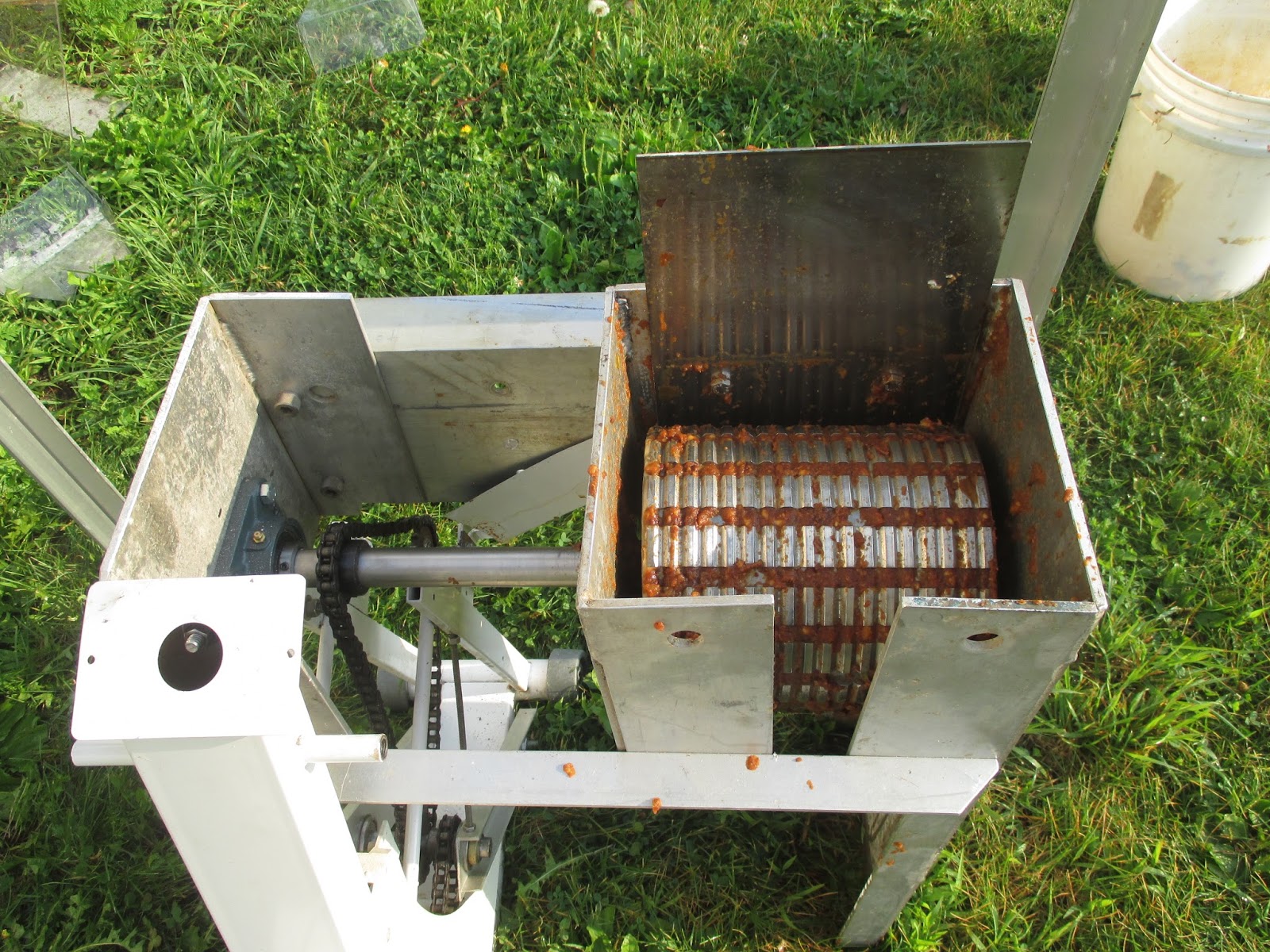
 I searched Craig's List for options and found an ancient grape crusher for $50 available two hours away. I brought it home, disassembled and cleaned it, but decided it would take a few days to both connect it for pedal power and also modify it. The two drums that rotate at different speeds are open at each end and were filled with dried grape stems, seeds and skins. These need to be sealed so they can be readily cleaned without disassembly.  
Top View of a Fruit Crusher. The Two Drums Rotate At Different Speeds So They Clean Each Other.
Side View of Fruit Crusher Showing Drive Handle and Spring Loading Mechanism That Pushes One Drum Against the Other.
My goals for the weekend were to start five-gallons of apple cider fermenting and to make a large batch of apple sauce. The quickest way to do both is to use a squeezer that separates pulp from skins, stems and cores. 
"Squeezo" Fruit Grinder That Separates Apple Peel, Stems and Cores From Pulp/Juice.
To remove the apple bits from the juice I made five platens that had hollow cores and tops with lots of holes that allowed juice to flow unimpeded. A gallon of apple pulp was loaded into a frame lined with a piece of cloth ten times the size of the platen. After folding over all sides of the cloth, the frame was removed and another platen placed on top and the process repeated. Once the five sandwiches of platens and wrapped apple pumice were complete, it took only ten minutes of pushing slightly on the hydraulic press to turn the layers of apple to moist fruit leather. It took two pressings using five 5-gallon pails of apples to make five gallons of cider.
Hydraulic Press With Receiving Tray, Five Platens, and a Frame for Holding a Cloth While Filling with Two Inches of Apple Pulp. The Cloth Is Folded Over in Every Direction and the Frame Removed. When All Layers are Complete, A Solid Plate Is Placed on Top and the Stack Compressed by the Hydraulic Cylinder. The Juice Flows Into the White Tray on the Bottom and Drains out a Hole into a Bucket on the Ground.
I had to process about eight more gallons of apples to make enough juice to make three gallons of moist fruit leather into proper consistency apple sauce. Cleanup took only a few minutes to rinse the metal parts in water. The cloths were folded, placed in a plastic bag and frozen until next batch. After adding some sugar and cinnamon, the processed apples made 30 pint jars of applesauce.
Next Year's Supply of Apple Sauce.