Anticipating the largest apple harvest in over a decade, I modified an exercise bicycle so that I can grind up apples by pedaling with my feet, while cutting up the apples by hand and removing bad parts. We pick apples for eating and those used for pies and baked goods, but it takes too long to pick the dozens of bushels ripening this year. We need a way to squeeze the juice out of apples we pick off the ground that's quick and easy. Adding a second shaft to the exercise bike makes it easy to change the gear ratio between the pedals and the drum that grinds fruit. If it's easy to do, make the drum turn faster than you pedal. If it's difficult, gear it down.
 |
| Exercise Bike Closeup Showing Intermediate Shaft That Allows the End Drive to Rise Well Above the Pedals and an Easy Way to Change Gear Ratio. |
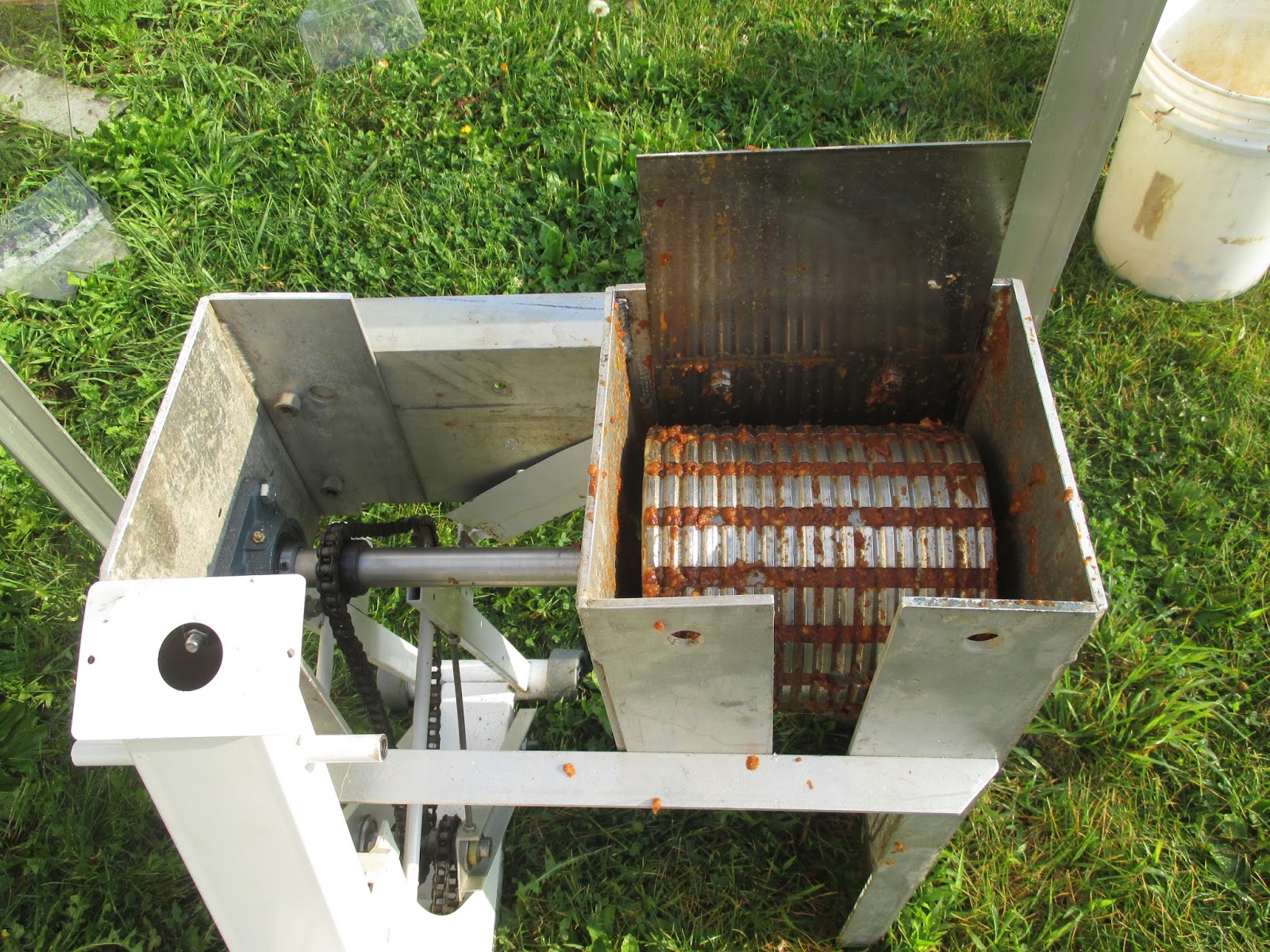
The drum I chose came from an auction many years ago and is welded to a shaft, all stainless steel. The drum has grooves that quickly grind up apples but then fill up and require lots of hand work to continue working. I tried different thickness plates for the drum to mash apples against, but all three didn't change throughput. They all took a lot of work to enable it to continue mashing apples.
 |
| View of Drum Showing Grooves Filled With Mashed Apples |
 |
| The Pedal-powered Apple Masher Showing Processing Table and Feeding Chute but Not a 5-Gallon Pail that Receives the Mashed Apple |
Once you have many pails filled with ground up apples, there is the task of separating the juice from the rest. I built a conventional slat-lined cylinder that I hoped would let liquid quickly flow down to a tray that emptied into a bucket. I used a 12 ton hydraulic press to push on a tightly fitted piston. The first quart came out very quickly but then slowed way down until almost nothing more came out. Even with many additional tons of pressure on the top, very little cider came out the open strips between the slats. With over 5 gallons of mash in the cylinder, less than a gallon seeped out in 14 hours, periodically pumping the hydraulic ram. It seems that the volumes of pulp near the openings between the slats quickly drained away and blocked liquid from the interior from getting through.
 |
| Hydraulic Press with Oak Slat Cylinder Filled with Apple Mash and Pressed for 14 Hours. Only Material Near the Openings Lost Liquid, the Rest Was As Wet As It Went In. |
I searched Craig's List for options and found an ancient grape crusher for $50 available two hours away. I brought it home, disassembled and cleaned it, but decided it would take a few days to both connect it for pedal power and also modify it. The two drums that rotate at different speeds are open at each end and were filled with dried grape stems, seeds and skins. These need to be sealed so they can be readily cleaned without disassembly.
 |
| Top View of a Fruit Crusher. The Two Drums Rotate At Different Speeds So They Clean Each Other. |
 |
| Side View of Fruit Crusher Showing Drive Handle and Spring Loading Mechanism That Pushes One Drum Against the Other. |
My goals for the weekend were to start five-gallons of apple cider fermenting and to make a large batch of apple sauce. The quickest way to do both is to use a squeezer that separates pulp from skins, stems and cores.
 |
| "Squeezo" Fruit Grinder That Separates Apple Peel, Stems and Cores From Pulp/Juice. |
To remove the apple bits from the juice I made five platens that had hollow cores and tops with lots of holes that allowed juice to flow unimpeded. A gallon of apple pulp was loaded into a frame lined with a piece of cloth ten times the size of the platen. After folding over all sides of the cloth, the frame was removed and another platen placed on top and the process repeated. Once the five sandwiches of platens and wrapped apple pumice were complete, it took only ten minutes of pushing slightly on the hydraulic press to turn the layers of apple to moist fruit leather. It took two pressings using five 5-gallon pails of apples to make five gallons of cider.
 |
| Hydraulic Press With Receiving Tray, Five Platens, and a Frame for Holding a Cloth While Filling with Two Inches of Apple Pulp. The Cloth Is Folded Over in Every Direction and the Frame Removed. When All Layers are Complete, A Solid Plate Is Placed on Top and the Stack Compressed by the Hydraulic Cylinder. The Juice Flows Into the White Tray on the Bottom and Drains out a Hole into a Bucket on the Ground. |
I had to process about eight more gallons of apples to make enough juice to make three gallons of moist fruit leather into proper consistency apple sauce. Cleanup took only a few minutes to rinse the metal parts in water. The cloths were folded, placed in a plastic bag and frozen until next batch. After adding some sugar and cinnamon, the processed apples made 30 pint jars of applesauce.
 |
| Next Year's Supply of Apple Sauce. |