Showing posts with label dehydrator. Show all posts

Sunday, August 7, 2016

Hiking Food: No-Bake Vegetable Crackers

I plan a long hike with one of my daughters this fall. Rather than bring commercial processed food I hope to primarily eat food we collected or grew locally. Last month I made ten sheets of fruit leather using our raspberries, gooseberries and apple sauce. Next steps: energy bars and crackers.
Raspberry, Gooseberry and Applesauce Fruit Leather
I found a recipe that added together a variety of raw minced herbs and vegetables that are spread on sheets and dehydrated. Rather than follow the suggested ingredients, using a food processor I pureed 14 cups of summer squash, two cups of garlic, two onions, four cups of boiled chestnuts and a cup of fresh basil/oregano leaves. I then added a cup of olive oil and three cups of flaxseed ground with an ounce of dehydrated hot peppers into a crumbly paste using a Corona flour mill. After thoroughly blending all these ingredients together, using an icing spatula, I spread this paste in 3/16 inch thick layers on nine 14 inch square non-stick sheets on wire rack shelves in our dehydrator.

Raw Ingredients for Vegetable Crackers: Summer Squash, Garlic Cloves, Onions and Boiled Chestnuts (from Freezer)
Onions and Garlic in the Food Processor, Pureed Squash in the Bowl, Ground Flax Seeds and Dried Pepper in the Square Container
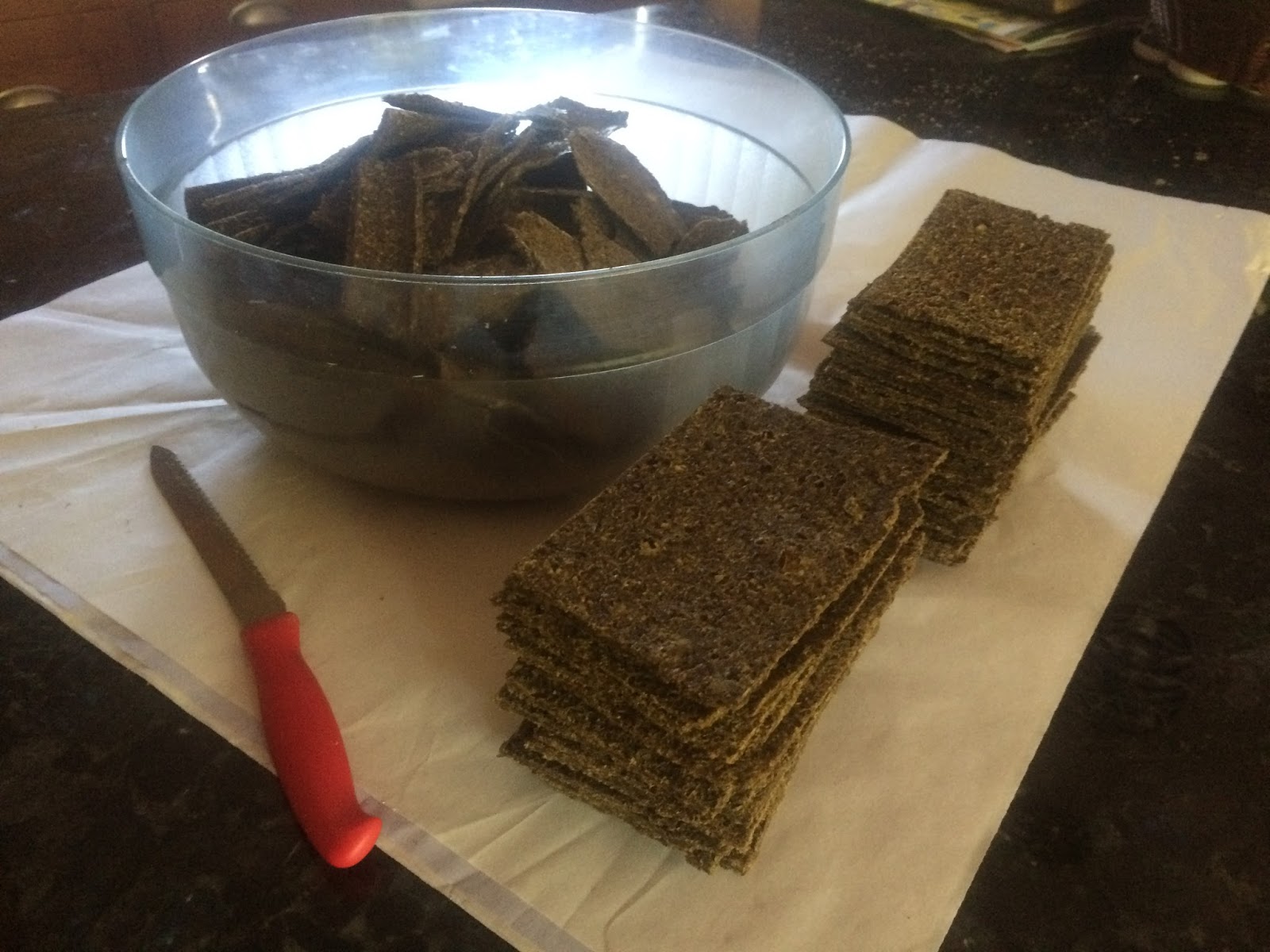
After 12 hours at 125F, the still sticky bottom of these sheets of vegetable paste peeled easily away from the teflon-coated fabric. With dry sides now resting on the wire racks, these sheets dried another 8 hours.  The result: three pounds of firm sheets that were easily subdivided using a serrated knife. I trimmed off the edges that curled up and make them into chips. The central portions became flat 3" x 4.5" crackers.
Sheets of "Vegetable Leather" That Will Become Chips and Crackers
Bowl of Vegetable Chips and Stacks of Crackeers
These crackers taste pretty good, though sprinkling salt makes them taste even better. What's next? Try versions with tomato paste, kale and a much higher ratio of boiled chestnuts. One goal: a great no-bake pizza cracker! Maybe by adding cheese and pepperoni to the above?

Tuesday, November 17, 2015

Saving Food: Apples, Cabbages, Peppers and Beans

It's November 17 and we still have a few dozen bushels of great tasting apples on four Granny Smith trees. 
One of Four Granny Smith Apple Tree Without Leaves But with Hundreds of Apples
We've given away many bushels, dehydrated more and have quite a few bushels waiting for processing. The few heavy frosts we've had haven't touched them. It's hard for me to see them go to waste, though they do help deer and other wildlife thrive. We have a year's supply of applesauce canned and 30 gallons of cider brewing or bottled but have run out of brewing vessels. Every few days I slice and dehydrate 40 or so apples into two gallons of chips. I'll probably pick another ten bushels before they freeze and store them under cover in the garage where I dehydrate them. When it gets way below freezing, they and the dehydrator will need to be transferred to the basement. 
Gallon Bags of Dehydrated Apple Slices and Other Drying Experiments
Three 5-gallon Carboys & Two 6-gallon Pails of Juice Fermenting 
Cabbages did not fair as well as the apples. I had to trim off the top leaves that were damaged by frost. The rest of the heads were still very crisp and hopefully will turn into great sauerkraut (white cabbage) and kimchi (red cabbage). The kimchi also has a few pounds each of garlic and sweet and jalapeño peppers mixed in for flavor. We have a total of seven gallons of these raw veggies slowing fermenting in the garage to extend their time to maturity while we eat more than a dozen fresh cabbage heads and pounds of peppers.
A Few Red Cabbages with Top Leaves Trimmed Off
Cross Section of A Red Cabbage
Five and Three Gallon Crocks Filled with Fermenting Cabbage and Other Veggies. Tops Are Weighing Down Plates That Keep Veggies Submerged in Brine.

Beans are easier to preserve than fruits and vegetables that have to be cut, shredded or squeezed. They simply have to be shelled and spread out to dry. Peppers, too, can be hung out to dry, and look good in one corner of the kitchen. Need a little heat in a dish? Pull one off and crumble it into the pot!

Scarlet Runner Beans in Various States of Drying
A Ristra of Alice's Favorite Hot Pepper (from a fellow seed saver) Hanging Out to Dry


Thursday, October 8, 2015

Dehydrating Fruits and Veggies

This year's apple and pear crops are the largest ever. We already have enough jars of canned applesauce so we were looking for other ways to preserve bumper crops. We tried dehydrating slices of apple in a small round plastic dehydrator but the heater failed so we ordered a large, all stainless steel appliance that has 10 large rectangular shelves. 

Granny Smith Apple Slices: Fresh
Granny Smith Apple Slices: Dry Are much Smaller than the Plump Slices Above.
Tomato Puree, 0.13 Inches Thick Covering a Layer of Teflon-coated Fiberglass.
Fresh Tomato Puree Ready to Lose Water: One-eighth Inch Thick Layers Became Paper Thin Chips. The Tomato Puree Coats the Teflon Coated Fabric.
We've now tried three different ways to make kale chips, three forms of apple slices, apple leather, two ways to dry tomatoes and make hot pepper slices. Next we will try slicing pears, many varieties of veggie chips, and venison jerky. 

Interesting apple statistics: it takes 26 large Granny Smith apples, weighing ten pounds, to make nine trays of skinless slices weighing nine pounds to make 1.8 pounds of dehydrated slices requiring eight hours of drying at 130 degrees F. 

Tomato stats: use a colander to remove five gallons of clear yellow liquid from six gallons of pureed tomato/tomatillos/garlic. Spread the thick ten pounds of red paste one-eighth inch thick on nine square feet of teflon coated sheets. Drying for ten hours at 130 degrees F. results in ten ounces of tomato "paper" that easily fits in a quart zip-lock bag.