Friday, January 29, 2016

Processing a Road-killed Deer: Who'll Eat the Dregs?

Early one morning a friend called to ask if I'd help process a deer. He had to get going. On his way to work he noticed a deer dead on the edge of a road that wasn't there the night before. He stopped, found it still warm, and brought it home. When I arrived, the deer was hanging, skinned, head down, from a tree limb. In less than 20 minutes we had the internal organs, the skin, the four quarters, thorax, back, and head in plastic bags and my friend was on his way to work. His family processed the front and hind quarters and I took the rest home.

It took all day to process the organs, remove/grind the meat and other parts, boil the bones and package the suet. We froze half the fresh meat in small packages, the other half as hot sausage ready for batches of soup. Most of that remaining we boiled in a large pot. After removing the boiled meat from bones, we separated the damaged portions and parts we didn't care to eat and froze them in plastic containers for our dog. Our cat wouldn't touch it!  The good parts we ground, added spices, formed into patties and transformed it into jerky in the dehydrator. We have yet to clean and process the hide, now frozen in the garage. 
Raw Suet For Birds Who Don't Eat Seeds
Food for Woodpeckers and Nuthatches: Rendered Suet
That left the digestive tract including stomachs filled with chewed corn kernels. Since the soil was thoroughly frozen, burying would take too much work. In years past, I've noticed that remains of dead animals quickly disappear and wondered who ate them. I placed the few pounds of stomachs and entrails next to the head on the ground in view of the trail camera. It didn't take long for crows to find the food stash. Besides a daily sniff by our dog, the camera captured many animals like cats, rabbits and an opossum that were just passing by but it took a few weeks until a fox and, few hours later, a coyote took them away. These weeks were quite cold with only a few hours above freezing, not long enough for items to thaw or decompose. Note the time stamp and temperature noted on the photos below.
The Camera Captured Many, Many Thousands of Crow Images
A Gray Tabby Feral Cat That Walked by Often
The Trail Camera Mounted on the Tree to the Right of the Deer Parts
A White-footed Feral Cat Walking by but not Even Sniffing
A Fox Just Checking It Out, Then Running Away
Mr. Gray Tabby
A Rabbit That Walked By Often

More Crows
Our Dog Belle Running Away Because I'm Calling Her
Mr. Cat
Another Crow
And Another
Rabbit on Alert 
An Opossum Walking By
Crows and Pheasant Sharing a Meal
A Fox Checking It Out
The Fox Worrying About Coyotes
The Fox Pacing After Nibbling Some Morsels
Another Bite!
A Coyote Shows Up
Looks Good Enough to Eat
I'd Better Grab it!
And Take It Where There Is No Camera
One Second Later: It's Gone!
Now Where Are We Going to Get Breakfast?
What Smells! There Have Been Many Different Animals Here!
Final thoughts: every bit of this animal is becoming part of another animal. This deer was hit by a vehicle that broke its backbone. We wondered why blood dripped from both its ears and mouth because it was hit on the side. I found out as I placed its head on the kitchen counter: an odd shaped copper mass fell out: a 45 caliber law-enforcement hollow-point hand gun slug that had expanded into a six-pointed star. The animal probably had been writhing, unable to get up. The entrance and exit holes did not bleed and were covered by hair.
45 Caliber Slug That Dropped on Counter

Tuesday, January 19, 2016

Bottling Cider


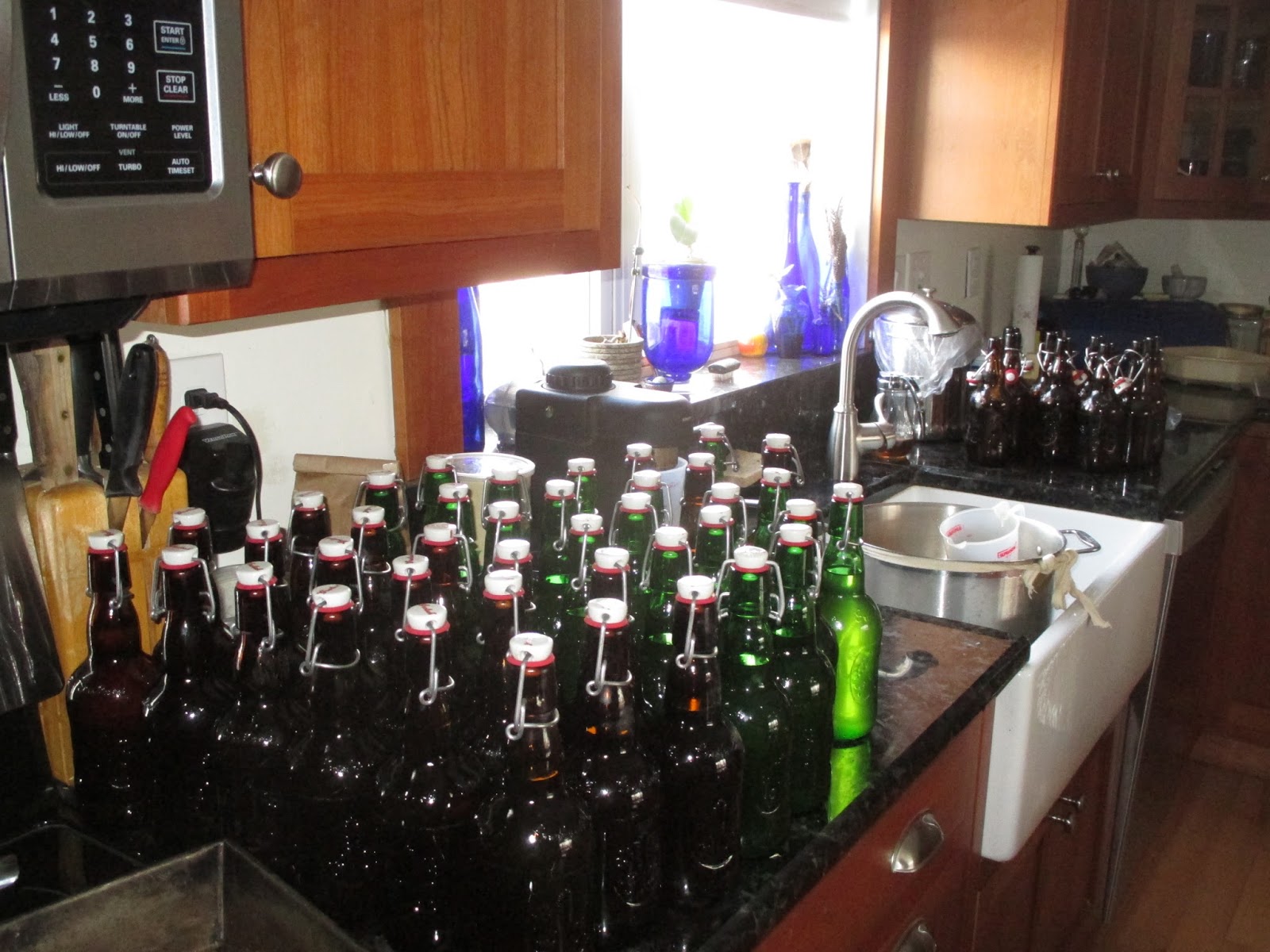
With outdoor temperatures below 20F and a raw wind blowing was a good time to bottle cider in the kitchen, by the warm stove. I had two six-gallon pails of pear and apple ciders that began fermenting last September. By December their fermentation locks no longer bubbled: yeast had transformed juice sugars to alcohol and carbon dioxide (the bubbles). As long as air (oxygen) does not contact brewed liquids (by keeping the air lock filled with water), one can keep it for months and bottle it a month before running out of finished ciders. It takes four to six weeks for yeast to carbonate cider in bottles.

I had accumulated about 10 gallons worth of empty bottles so I began processing the first two cider vessels: 6+ gallons of "hot" apple cider and 6 gallons of pear cider. By not moving the tall pails while carefully removing tops, I was able to ladle off three gallons of clear cider from both without filtering. I added 12 ounces of maple syrup (for the yeast to transform into carbonation) to each three gallon lot and filled 26 sixteen ounce flip-top bottles of each type. I decanted the remaining liquids through cloth filters, reserving the pear cider but filling another 25 bottles with the hot pepper apple cider. 

Last September: I had placed 100 pureed jalapeño peppers, including seeds, in a cloth bag and boiled in cider for 20 minutes. I then added this clear, red tea to the brew to heat up this apple cider. At this point it tastes a bit too hot but time and mellowing while fermenting to create carbonation should make this an exciting beverage.

The second half of the pear cider will go to friends who have a relative who is fond of this beverage.
Empties on the Right, Pot of Brewed Cider Spiked with Maple Syrup in the Sink, Filled Bottles on the Left


Monday, January 18, 2016

Midway Through the Heating Season

It takes weeks for outdoor temperatures to catch the earth's dance around the sun. The hottest time of year is usually not the longest day, first day of summer, and the coldest rarely occurs around December 21, the shortest day. Seasons reflect this phenomenon by getting colder as winter progresses and the sun shines longer every day. Today in mid January we're halfway through a typical heating season - having burned half the wood we'll need to keep warm. It's been an extremely mild winter, so far. This month we even had a thunderstorm with a rainbow and haven't had to shovel the driveway yet, though we did have to sweep a few inches of snow off the deck.
So Far We've Burned Less Than a Quarter of Our Two Year Wood Supply
Rare January Rainbow
Tracks Plastered to Deck Boards Resist Sweeping
The pond finally froze over earlier this month and we had to install the bubbler to aerate the water. This also melts a large hole in the ice. Colder days shrink the size of the hole, warmer days expand it. Our neighbors' fish died last winter from lack of oxygen because heavy snow blocked sunlight from reaching underwater plants. Last week I installed a bubbler in their pond and they are enjoying an otter frolicking around the resulting hole and scooting up on the surrounding ice. 
Our Almost Frozen Pond
Pond Frozen All Across
Hole in Pond Ice by a Bubbler
Recently, a few nights went near zero so we had to bring the carboys of fermenting cider indoors. We also had to move the Granny Smith apples into the greenhouse where we crushed and squeezed most of them into 17 gallons of cider. We still have half a bushel for eating fresh and pies. When it is windy and well below freezing outdoors, sun warms the greenhouse to 50-60 degrees making it pleasant to work in shirtsleeves. Night time temperatures there drop to the low 30's. 
Row of 11 Buckets/Carboys of Fermenting Apple Cider, Pear, Grape and Berry Juices
Our Local Male Pheasant Out for a Stroll


Monday, December 7, 2015

First Pond Ice

It's December 7 and this morning a third of the pond was covered with ice. By noon most had melted. Yesterday we had an otter over two feet long visit us. It stayed only a few hours, scampering around the dock and diving to catch lunch before moving on.
View to the West Showing Ice Cover on Far Side
Pond View to the North, With the West Third Covered With Ice
This autumn has been remarkably mild, with more than 1,000 fresh, unfrozen Granny Smith apples still hanging on trees. We have dehydrated more than 100 pounds and have stored many times that amount in bins. Since we don't need any more apple sauce or dried slices, we'll probably juice them and make hard cider that will last more than a year. That way we can enjoy apples even if next year's crop fails. 
Apples on Trees With Heavy Frosted Grass in Foreground
A remarkable plant started blooming last week: A Winter Rose or Hellebore that is an amazing evergreen perennial with handsome, deep green foliage and pretty flowers that shine through winter and into spring. Our other flowers have frozen and are gone but this one is thriving! We'll have to propagate it and find other colors to help us through cold winters! We'll have to plant them where snow doesn't pile up. This flower will spend most of the winter under the snow that gets piled along the driveway unless we protect it and avoid shoveling on top of it.
Winter Rose
Closeup: Winter Rose

Sunday, December 6, 2015

Milling Logs to Boards: Part 2

It took three tries  but weather finally allowed us to process more logs. The site is very close to the large barn where boards are stored for two or more years to dry. This batch of logs included red oak, mulberry, walnut, cherry and hemlock. Three of the logs were cut into large slabs that were subsequently chainsawed into roughly square pieces that we sealed on both ends to retard drying so the ends dry at the same rate as the rest and don't crack or check.
Roughing Out Wood Bowl Blanks
Bowl Blanks Sealed and Ready for Transport to the Barn for Drying
Since this milling process took place on mowed grass and not in a forest like last time, we spread a very large tarp on the ground under the mill to make it easy to collect and remove sawdust and debris.
Two Red Oak and Three Walnut Logs Lined Up for Milling
The Mill Has Six Jacks for Leveling
Each Jack Incorporates a Row of Holes and a Spring-loaded Pin and Require Only a Single Lever to Adjust All Sequentially
First Log of the Day Being Cleaned of Dirt and Stones to Prevent Damaging the Blade
Delivery of a Very Large Red Oak Log
 The raw lumber is stacked inside a large barn. One inch square "stickers" are placed along the length so that air can circulate through each row to facilitate natural drying. Boards in a row are spaced an inch or two apart so edges dry properly.

Lumber Cut in the Morning, Now Stacked, Will Dry for
Two Years Before Being Auctioned to Support the Club.
View of Some of Last Year's Planks That Will Be Auctioned Next Year
A Tall Stack of Last Years's Boards