Monday, July 18, 2016

Letting Everyone Know How Much Rain and Snow Falls:

I've been monitoring rainfall during growing seasons since I began gardening so I know when less than an inch of rain falls in a week - indicating that it may be time to water sensitive plants. Neighbors know that I do this and often ask me rain amounts and I'm happy to share the data. This spring I attended a National Weather Service seminar on reporting significant weather events and they urged attendees to join CoCoRaHS  (pronounced KO-ko-rozz) , an acronym for the Community Collaborative Rain, Hail and Snow Network. I joined right away!
Rain Gage That Fills Up a Central Tube That Overflows Into the Surrounding Cylinder. This Enables Rainfall to Be Accurately Measured to 0.01 of an Inch. Overflow Is Simply Emptied Into the Center Tube (After Emptying It) and the Amounts Added Together.

The Gage Itself Is Unobtrusive, Can be mounted on a Fence or a Post Away From Buildings, Trees or Obstructions That May Affect Results.

What's required? Purchase an accurate rain gage ($30) and report what it collects every day at a specific time (me: 7AM) or, if you are away from home, when you return. It takes me less than a minute each morning to send the data: a single click to submit the pre-filled "zero" submission or typing in the few digits of actual precipitation of rain. This information is immediately available through the website:  

http://www.cocorahs.org/ 

I no longer write rainfall depths on the calendar because it's easier to poll the data from this website. If you want to know how much it rains here, just poll Station Number: NY-RN-13 and the dates of interest.
My Data From "View Data" Tab on http://www.cocorahs.org/ 
Consider joining this network for its largest value is its ability to warn of potential flooding. This community developed in response to devastating flooding in Colorado when no warning was broadcast and people died. Participants in the program are urged to rapidly submit periodic rainfall data during heavy rains so that the weather service can utilize the information. Doppler radar gives estimates, not rain that actually hits the ground. My neighbors still ask about rainfall numbers but are now also aware of this online resource. 

Sunday, July 17, 2016

Sustainable Poultry Odyssey

In the past we had ordered a variety of chicks, two dozen at a time, that arrived by post. Even though they matured into both roosters and hens, no mom ever became "broody" and incubated her eggs. Five years ago we again tried to develop a flock of sustainable poultry. At a tailgate sale we obtained two dozen white leghorn peeps, two Buff Orpington roosters and three matching hens. Although these fowl produced a phenomenal number of eggs the following years, none succeeded in producing offspring. One by one they succumbed to various maladies until we had only a single rooster. 

Spring, a year ago, we tried a different approach: a pair of young Guinea Fowl and a dozen "fertile" chicken eggs. The eggs never hatched and a year later we still had two vociferous fowl and the last of the earlier flock: a large Orpington rooster. Throughout an entire year we never found a Guinea fowl egg so our pair turned out to be both male. This spring we procured three Guinea hens to attract their attention. Within a few weeks we started finding eggs in the nesting boxes located in the chicken tractor. Eventually they decided laying eggs only in the upper left box. After it contained about 30 eggs, one of the Guinea hens began sitting on them. 
Our Buff Orpington Rooster and Two Male Guinea Fowl: Spot and
Dot
Closeup of Dot
The Dozen "Fertile" Eggs That Never Hatched: The Labels Help Orienting Them When Turning Then Every Day
The other two Guinea fowl, now blocked from laying eggs in the common nest by the broody fowl, found a secret place in some brush to lay their eggs. When clearing a patch of brush we came across the nest and collected the eggs because we didn't want the local fox to eat them or one of our fowl. We watched in horror a fox stalking our flock and successfully grabbing one by the tail. Guinea fowl are very strong fliers and it got away, leaving only a trail of many dozen feathers!
Part of the Trail of Feathers Left by the Fox
The First Hidden Guinea Fowl Nest
A week later we discovered a second nest with eggs and have been periodically snitching some of the eggs so that they never total more than ten. So far, they only visit the nest to lay eggs and show no tendency to brood. 
The Second Hidden Guinea Fowl Nest That We Rob Every Few Days
Our Egg Basket With Eggs From the Nest Above
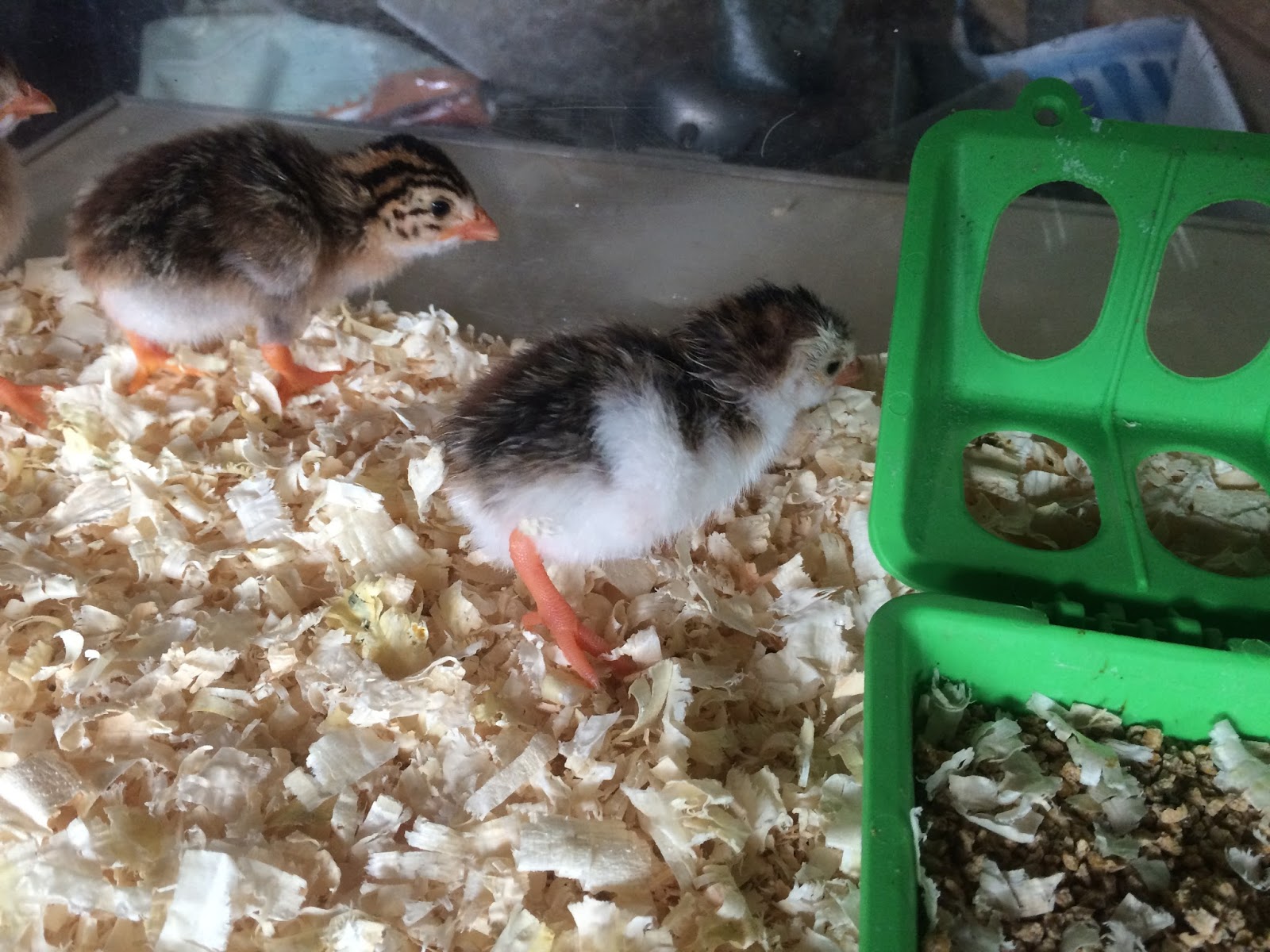
The incubation period for chickens is around 21 days and we were disappointed that no keets (a baby Guinea fowl) appeared under the brooding Guinea fowl in 24 days, then 28, then 30. But on day 32 I saw a tiny keet on its mom's back. We couldn't imagine a keet surviving a five foot drop from her nesting box, nor would it be safe for them to live on the ground in the chicken tractor along with now eight full size birds. An internet search revealed that Guinea fowl moms are not especially good at taking care of their young and most recommended raising keets by hand
Our First Two Keets on the Pile of Eggs Their Mom Had been Sitting on For More Than 30 Days
Basket of Keets on Their Way to the Nursery
Picking Keets One-by-one so Each Can Have Its Bill Dipped Into the Water Trough to Insure It Knows Where to Get a Drink
Keets Huddled Under the Heat Lamp
Keets Basking in Early Morning Sun That They Like Better Than the Heat Lamp
We set up a nursery with game bird kibble, water and a heat lamp and secreted 13 keets away from their mom. She still had 30 eggs under her when she decided she had no future sitting on them and she left them ever longer periods. I fired up our incubator and transferred half the remaining eggs to it. The first night one hatched with four the next day. We now have 17 keets requiring attention at least  four times a day - for the next six weeks!
The Second Transfer of Keets from Under Their Mom Including the Only Grey Colored One
Incubator With Two Hatched Eggs
A Keet With Feathers Still Wet From Being Inside An Egg
The Last Keet to Hatch in the Incubator Has White Wings and Breast!
Rooster and One Fowl Inside the Chicken Tractor, One Outside

Our Red Hen and Spitzhaben Rooster With Two Guinea Fowl

Four Guinea Fowl Roaming a Field, Looking for Ticks and Other Things to Eat


Tuesday, July 12, 2016

Vine Trellis or Bean Tunnel

Every week we have the pleasure of entertaining twins, now three-years old, who like to pick and immediately eat fruit and veggies from the garden. Images of different trellises with horizontal sections that have beans hanging down look attractive and very functional. How neat would it be to have a long tunnel that was tall enough so hanging beans along the center would not hit your head? If in the shape of an arch, kids can readily choose their favorite colors and pick beans along the sides hanging at their level.
Bean Tunnel: Under Construction
Setup for Bending Arches Over Wood Form
Tools and Fasteners Needed  to Bend and Connect the Aluminum Extrusions Together
I have a lot of aluminum extrusions left over from building solar collectors. One type, 13 feet long, is especially easy to both bend and join together. Trials arrived at arches that use one and a half lengths that are bent to be 80 inches high at the center and eight feet wide at the base, with  each end 8 inches below ground. The tunnel is 51 feet long with 27 arches. To support trellis netting, string and cable lash six members of the same material perpendicular to the arches and run the length of the tunnel.
Early View Looking South
Four kinds of beans, along with some cucumbers and fancy squash, grow on both sides of the arches. To minimize planting effort, only a narrow strip of soil on each side was prepared and heavily mulched. For easy maintenance, both ends of the tunnel have gates so that grass inside the tunnel can be mowed. A knee-high rabbit proof fence around the facility keeps critters from eating the plants. Experience shows that any vine that winds into the fencing has to be rerouted to prevent it from being nibbled off. They must be very tasty.
North End Showing Squash and Trellis Netting
It will be awhile before the various vines climb over the top of the trellis netting, flower and hang their fruit inside!

Inside View Looking North
Gate Prevents Critters from Eating Plants Inside

Thursday, July 7, 2016

Making Raspberry Jam

Our raspberries ripen before currents, gooseberries, blackberries and blueberries. We enjoy adding jams to various cake and pastries and that made from pure raspberries is our favorite. Jam and jellies for sandwiches tolerate mixing whatever fruit are ripe as does juice concentrate that we use year round for beverages.

Raspberries Ready for Picking
Two heavy rains put a very welcome end to an extended dry period that prevented berries from growing to normal size. Our earliest raspberries are tiny but those following are normal size to large. Our first picking yielded 8 cups of juice through our "Squeezo" processor that removes more than half the raspberry seeds. Small seeds get through the sieve. This amount made two batches of jam: six each 12 ounce jars and four half pints.
Raspberries Ready for Processing
This "Squeezo" Separates Juice and Pulp from Solids, Like Seeds and Stems.
Yield: Six 12 Ounce Jars and Four 8 Ounce Jars of Raspberry Jam


Friday, July 1, 2016

Processing Garlic Scapes

In June, hardneck garlic produce scapes, flower "buds" that produce small garlic bulbils. Bulbils are tiny, undivided bulbs that can be used as seed. Garlic do not have fertile flowers so do not produce true seeds. 

See: https://www.cog.ca/uploads/TCOG%20Articles/Growing%20garlic%20from%20bulbils.pdf
Curly Garlic Scapes Emerging  from the center of Garlic Plants
Some years we let some of these scapes produce large bulbils that we plant. The following year, each bulbil becomes a single large clove, ideal for processing. These are sometimes available in farmers' markets at a premium because these large cloves are so easy to peel and a single one is perfect for many dishes. In the second year, each of these former bulbils become an ordinary garlic with a dozen, or so, cloves. But if garlic scapes are left unattended, these bulbils get distributed (each year we rotate every crop) overproducing and becoming weeds, literally, thousands of garlic plants competing with everything. One former garlic bed, long abandoned, is so thick with overcrowded garlic, it looks like grass!
Last Year's Missed Bulbils with Scapes: Imagine If All the Bulbils in These Scapes Matured and Planted Themselves. Result? Garlic Grass!

Garlic Scapes Ready for Harvesting
We're trying to get on top of our garlic's propensity to take over our growing spaces and rigorously harvest every scape. Should any escape and, left on their own, they become a dozen or two garlic plants not far from where they grew.  Early scapes are much more tender than later ones so we pick them as soon as they appear. It's sad that the plants continue to grow scape stems after picking them early, but the resources needed to produce bulbils goes into cloves below ground. 
Belle and First of Two Baskets of Garlic Scapes
This year, after cutting off the fibrous "hat", we chopped these scapes in a food processor, portioned them into sandwich bags and sealed in zip-lock gallon bags for freezing. Our 200 square feet of garlic plants made 6 pounds of chopped scapes, ready for 30 to 50 pestos, soups and curries.

Garlic Scape Processing Operation

Sunday, June 26, 2016

Woodchuck Rascals!

Our vegetables have been severely challenged by woodchucks. They've eaten half the greens in our greenhouse, our hot peppers, our corn and associated beans. Every year they do some damage because they tunnel under fences but we quickly block and trap them. This year they snuck into both our greenhouse and hot pepper patch and decimated them before we could react. 

We tolerate deer that nibble some of our corn, peas and tomatoes every year for these browsers don't decimate whole rows. They simply taste a few plants and move on, leaving much more than they eat. Woodchucks are different: they consume whole rows. And instead of chewing off a few leaves, they often eat or pull out whole plants, leaving roots to dry up and die!
A Woodchuck on Alert Having Eaten Most of a Parsley Bed
Rabbits Are Not as Destructive as Woodchucks
Corn Damage: Rabbit, Deer or Woodchuck? 
Woodchuck Ambling Through Corn: June 22, 2016
Woodchuck Returning the Next Day
Woodchuck Pepper Damage: No Leaves Left, Only a Flower
Deer Eating Corn After Midnight
Four Pea Stems Chewed by Deer: <20% of the Plant

Wednesday, June 8, 2016

Making Birds Ignor Strawberries

I found an interesting technique for fooling birds so they leave ripe strawberries alone: paint pebbles red and scatter them around the strawberry bed. Theory: birds peck the red stones, find they are inedible and then leave red tidbits alone. But do decoys work?

I spray painted around three dozen pebbles "gloss cherry" red and placed them near bunches of ripening strawberries. Some berries are still being damaged but it is still early in the season. Very likely there will be other pests that will reduce our harvest. Already I'm finding slugs eating ripe berries and since they don't have eyes, red stones won't deter them! Chipmunks ate a lot last year and I think they go for the smell of ripe berries. 

Red Painted Stone Near a Ripening Strawberry
Undamaged Strawberries and Red Stone
Bites Taken Out of a Strawberry Near a Red Stone!
A Slug Eating a Strawberry, Ignoring the Red Stone!