 |
| Garlic Cloves Going into Rows with Hay Fork, Bucket for Worms and Carton of Separated Cloves |
Showing posts with label Mulch. Show all posts
Showing posts with label Mulch. Show all posts
Wednesday, November 16, 2016
Planting Garlic
I have been too busy to get our garlic in the ground before my target date: October 31. In September, a family member helped separate the best 350 cloves from heads but they sat in a carton waiting to complete harvesting, a birthday celebration, a hike and a quick visit to both west coast daughters. A dear friend planted almost half while we were away for two weeks that enabled me to plant the rest in only a few hours.
My favorite tool for planting is a hay fork because its skinny tines slip so easily in our soft soil and don't often hurt the worms that are so plentiful. Most of the worms, grubs and caterpillars end up in a pail for transport to the chickens and Guinea fowl. The garlic beds get covered with a few inches of ground up leaves and grass for insulation and weed/moisture control. By next June, most of this organic matter will have been processed by worms so that the bed is ready for parsley seeds.


Sunday, May 15, 2016
Time for Planting Seedlings
Although it may freeze tonight, some seedlings can tolerate cold nights. Over the past two days I planted our five types of sprouted onions and later today will start setting out cabbages, Brussel sprouts and kale. Later this week should warm up enough to set out tomatoes, eggplant and peppers.
 |
| Flower and Vegetable Seedlings Waiting for Warmer Weather Before Growing Outdoors |
 |
| More Then 100 Tomato Plants Fit in a Small Area |
The newsprint tube seedling holders is working out very well: No winding up of roots at the bottom and they make it very easy to transplant seedlings. They readily slide out of their containers and do not stick together. Many of the onion tubes had more than the optimal three plants and were easy to separate into groups of two or three. Roots were not tangled and readily pulled apart, a chore that was impossible with shorter vessels without breaking rootlets. The tubes that had two or three layers of newsprint were too robust and resisted tearing down their entire length. Removing the newsprint and adding it to the surrounding mulch seemed appropriate to prevent it from impeding root growth. A single layer with overlap for glue proved most appropriate.
 |
| Onion Sprouts Ready for Planting |
 |
| Onions Planted in Mulch, Garlic Behind |
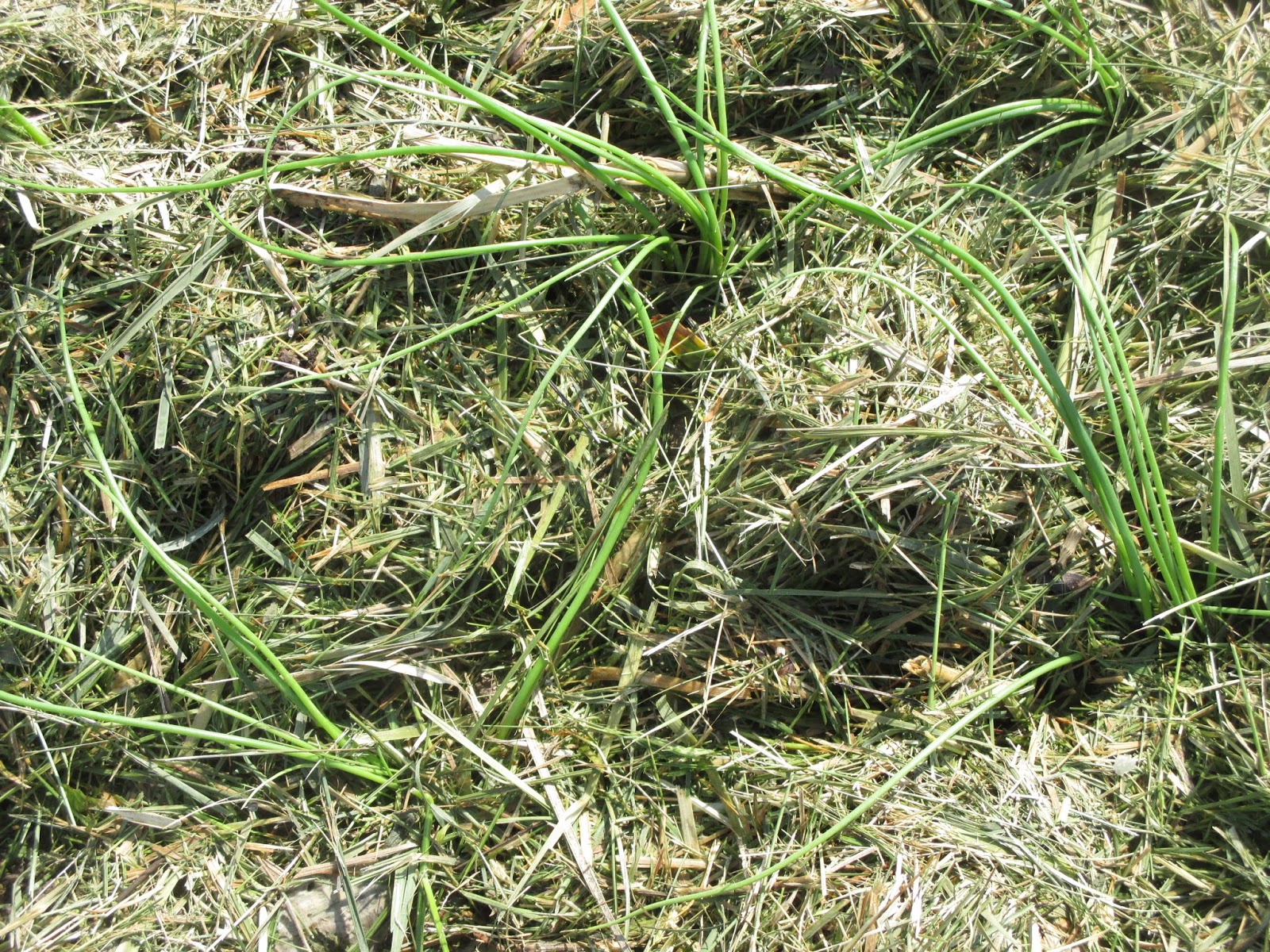 |
| Closeup of Some Onions |
 |
| Directly Seeded Sugar-snap Peas Growing Well |
Saturday, May 14, 2016
Grass for Mulch
We have a few acres of fields that I mow in spring and early summer for garden mulch. After July they simply grow untended except for a few paths that help us avoid ticks, burrs and wet shoes. The first cutting in spring is substantial because it includes both early new growth and plants that died over winter.
Because dry plant matter is easy to handle, works better as mulch than wet grass that heats up and decays within a few hours, and can be used to cover sensitive plantings if frost threatens, I initially mow fields a few sunny days before picking it up. This year our first harvest of mulch delivered four trailers full plus over 100 bags (the bagging feature of the mower fills three at a time) all together totaling over 30 cubic yards of mulch.
Filling the trailer behind the mower requires the grass to travel more than ten feet through a large articulated tube that only works well with dry matter easily transported by the blower. Wet material clogs the system. This combination of tractor/mower and trailer connected by a tube requires a large turning radius so it can only be used by proceeding clockwise around two large fields. Filling the trailer that fits about 40 bags of mulch is a huge time and fuel saver because it avoids so many back-and-forth trips to garden plots. For a few years I emptied the bags into the conveniently located trailer but then emptying the trailer required removing the bagging system. And it's a lot of work emptying bags every five minutes, the time it takes to fill them. The trailer sides and top are now lined with mesh that catches the mulch thrown by the hurricane of air that transports it from the mower. It now takes less than a day to pick up the four trailers and 100 bags of mulch that used to take many days.
Worth noting: last year's mulch has essentially disappeared by this time and gardens are bare soil except for corn stalks, tomato vines and pepper skeletons from the crops themselves. The nutrients in the mulch have been processed into the soil by worms, bacteria and fungi.
Because dry plant matter is easy to handle, works better as mulch than wet grass that heats up and decays within a few hours, and can be used to cover sensitive plantings if frost threatens, I initially mow fields a few sunny days before picking it up. This year our first harvest of mulch delivered four trailers full plus over 100 bags (the bagging feature of the mower fills three at a time) all together totaling over 30 cubic yards of mulch.
 |
| Diesel Tractor Connected to a Trailer That Catches Dry Grass Delivered by the Mower Via an Articulated Tube |
 |
| Tractor with Bagging System |
 |
| View Showing Dry Grass Surrounded by Field Where Mulch Has Been Picked Up |
 |
| Mulch Ready for Distributing Around Garden |
Hours driving around fields are not boring. There are dozens of birds to watch, baby rabbits, snakes and frogs to avoid, and other wonders to ponder. The fields have animal paths crossing them and often matted grass that show where deer bedded. Once in awhile I have to escort a newborn fawn from harms way for they refuse to move on their own.
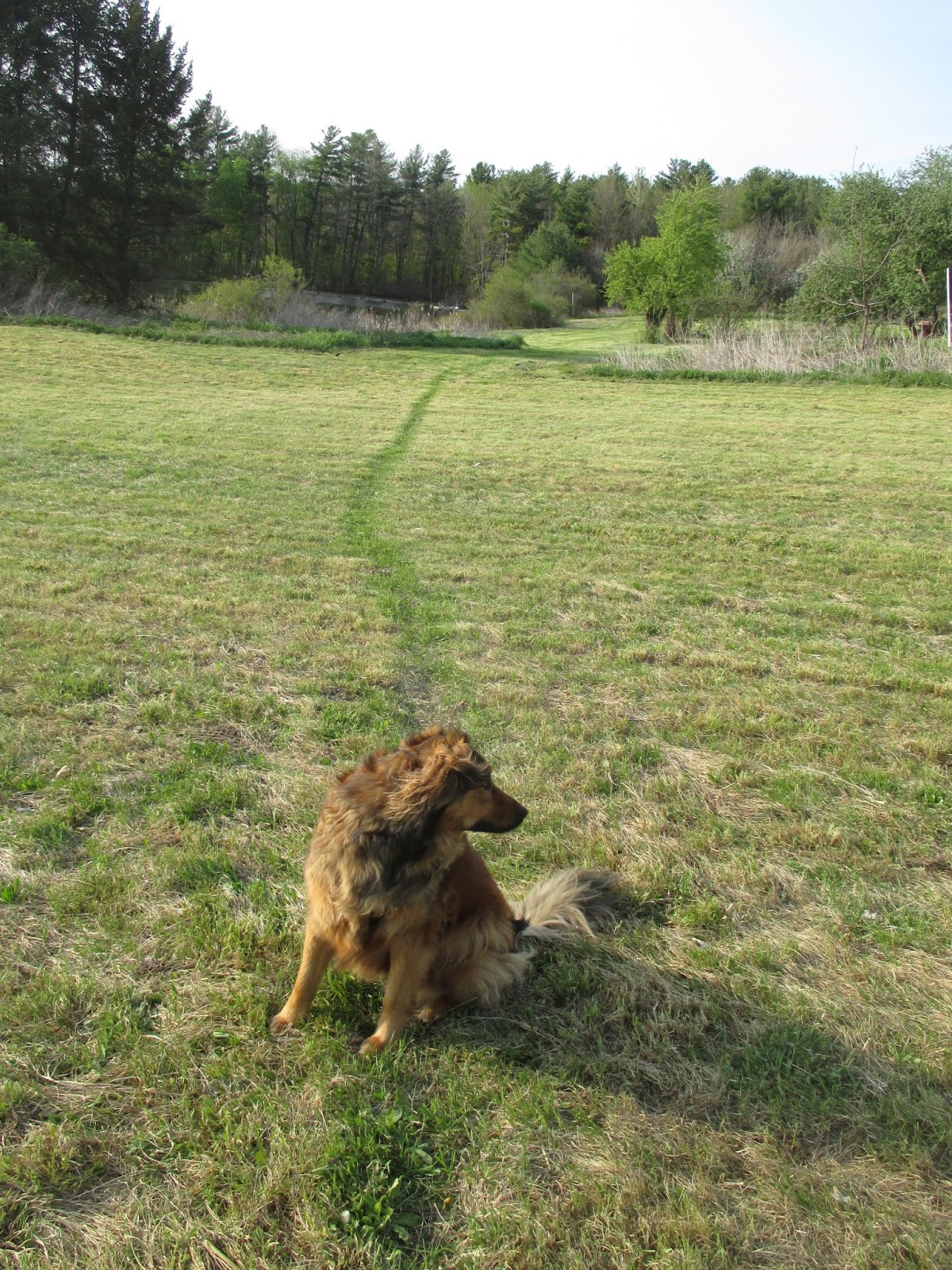 |
| Belle, Our Dog, Sitting on a Deer Path Through Our Harvested Field. Their Hooves Trim the Dead Grass To Allow New Grass to Grow More Vigorously Than the Rest. |
Saturday, May 23, 2015
Freeze Protecting Tomatoes, Beans & Peppers
Our typical last day of frost is May 15th and in a good year, the last freeze occurs in April. This year we have had a very cold spring but once it warmed up, it stayed warm - until last night, May 22, there were frost warnings. In addition to hundreds of flowers, we have about 300 peppers, 150 tomatoes, 100 beans and few hundred sweet corn plants in outdoor gardens. A severe frost would kill or severely damage any not covered by containers or blankets. We simply don't have enough of these to cover thousands of square feet.
For the last week I've been mowing fields and using the dried grass clippings for mulch - a few acres of the stuff. It's been very dry so the grass has remained very fluffy. I do this every year to eliminate weeds, conserve moisture, and add nutrients. By the end of the summer, worms have consumed more than half of this organic matter. I realized that loose mulch on either side of sensitive plants can be pushed together to support a cap of more mulch placed on top without hurting 2 to 5 inch tall pepper, tomato and corn plants. Using the mulch in the beds, it took only an hour to build grass huts over more than 600 plants!
Our supply of blankets, towels, tarps and boxes readily covered the sensitive flower beds.
This morning, May 23, I got up at 5 AM. The thermometer I had placed on a flower bed overnight registered 28 F, a killing frost. I waited a few hours for the sun to warm the air before removing the grass tents. Wind gust had uncovered a few taller tomato plants and beans which were severely damaged, with limp and blackening leaves on top. They may come back. Peppers and corn all looked okay. It took two hours to uncover all the plants and redistribute the mulch, including pulling a few weeds.
For the last week I've been mowing fields and using the dried grass clippings for mulch - a few acres of the stuff. It's been very dry so the grass has remained very fluffy. I do this every year to eliminate weeds, conserve moisture, and add nutrients. By the end of the summer, worms have consumed more than half of this organic matter. I realized that loose mulch on either side of sensitive plants can be pushed together to support a cap of more mulch placed on top without hurting 2 to 5 inch tall pepper, tomato and corn plants. Using the mulch in the beds, it took only an hour to build grass huts over more than 600 plants!
 | ||||||||
Rows of Dried Grass Covering Sweet Corn
|


 |
| Raised Flower Beds Covered by Blankets Over Inverted Boxes |
 |
| Pepper Plants Uncovered |
 |
| Pole Beans Uncovered Before Adding Climbing Trellises |
 |
| A Row of Tomatoes Uncovered |
Subscribe to:
Posts (Atom)