Showing posts with label Maple Syrup. Show all posts

Tuesday, March 15, 2016

Maple Syrup and Working Wood

February and early March weather spurred maple trees to produce large amounts of sap. Five tapped trees produced 14 quarts of maple syrup so far but are tapering off. Our stove has been covered with steaming pots for the duration and we're looking forward to a cooler kitchen, without so much steam.
A Pot of Soup Shares the Stove Top with Five Pots of Maple Sap
Although gathering sap, feeding the fire, tending pots on the stove and insuring syrup does not become charcoal takes time, there were a few hours in between to complete woodworking tasks. I've been learning skills at Northeastern Woodworkers Association classes and the organization expects each member to contribute an object to be sold at the NWA Showcase being held in Saratoga, NY on April 2&3: 

http://www.nwawoodworkingshow.org/information.htm 

It's the largest woodworking show in the country and this is the 25th anniversary show and should be the most extravagant. In addition to the garden tote with white ash ends that will be on sale to benefit the club, I made another out of cherry to be on display in the flat-board section along with instruments, furniture, chests and fancy boxes. I have yet to complete a bowl for display in the wood-turners section. 

The organization supports many non-profit and other benefit efforts and I volunteered to make a vessel to hold "beads of courage" for some very sick child. These colorful beads are given kids when they undergo a procedure like drawing blood, getting imaged, receiving chemo or radiation treatment and shots. Many kids "earn" thousands of beads and need something to put them in. Some of the members made square boxes and others turned cylindrical vessels out of wood. I decided to encase a large plastic jar in wood with lots of open areas to view the beads inside. 

For more information see: http://www.beadsofcourage.org/

Bead Vessel: Top & Bottom Are Walnut, Knob Is Lilac
Horses Are Soft Maple, Poles Are Birch
Garden Tote: Ends Are White Ash, Sides Are Cherry, Handle Is a Hickory Stem and Woven Nylon-Coated Stainless Steel Cable Bottom 
Side View of Above Tote
End View of Above Tote
All Cherry Tote with a Cottonwood Handle Peeled by a Beaver
End View of Above Tote

Monday, April 20, 2015

Superlative Maple Sugaring Season

Sap started flowing here in upstate New York on March 12th and ended a few days ago. We pulled out our spiles on April 18th. These 14 maples delivered over 460 gallons of sap that my neighbor and I reduced to 12 gallons of maple syrup. I had to carry our portion in five gallon buckets of sap about a quarter mile, usually two at a time, together almost 80 pounds, almost a ton and a half altogether. The best part? The daily activity and multiple trips helped me lose 7 pounds of winter weight.

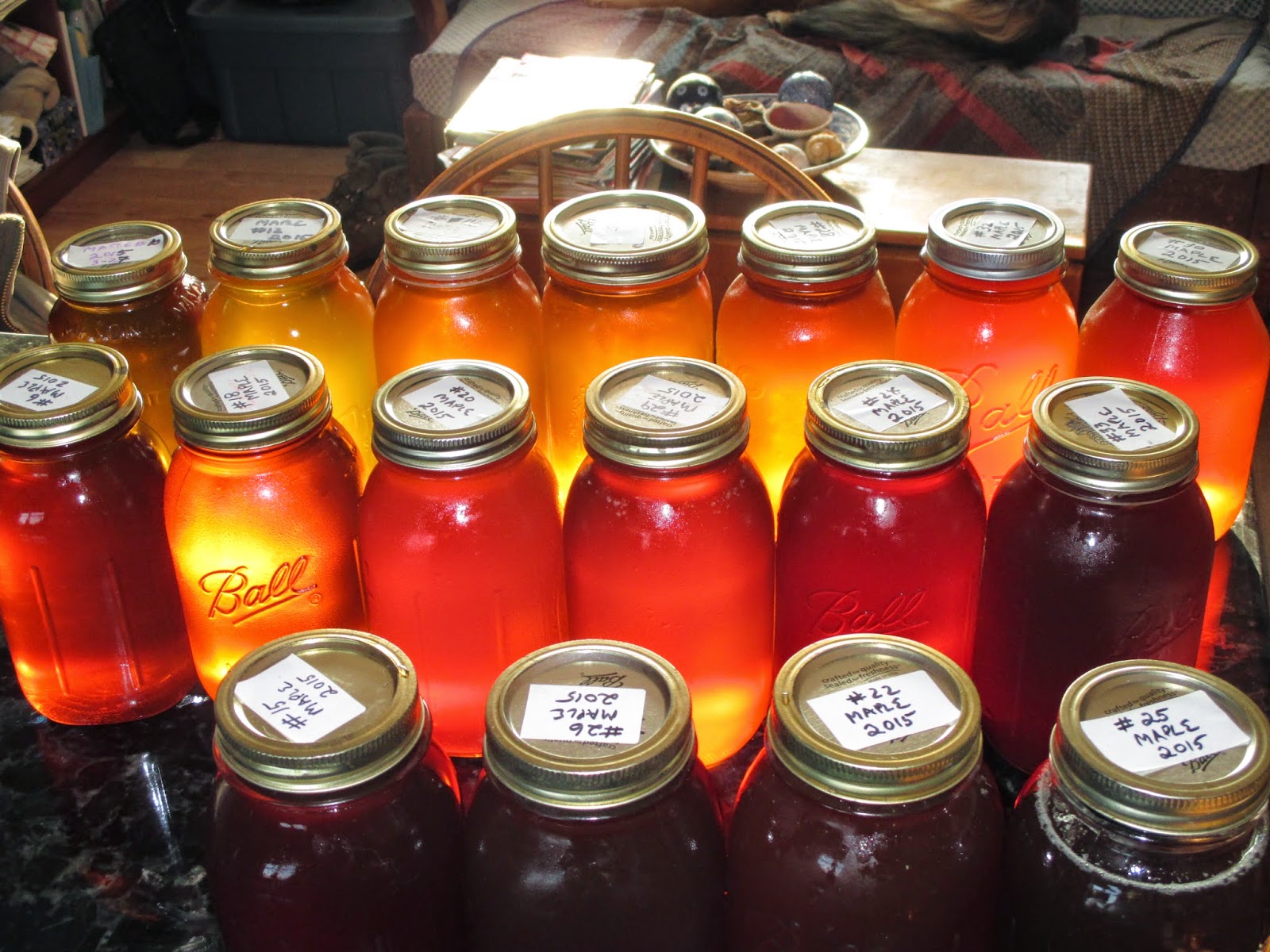
Early season maple syrup is quite light in color and as the season progresses, it get ever darker from nutrients trees add to the plasma. Some trees add more and their sap seems to diminish before the others. A few of the clear sap trees were still producing a quart or two of sap when all the others had stopped.
Eighteen of our 34 quarts of 2015 Maple Syrup
Quarts of Syrup Showing Changing Color, Sunshine from Behind, One Shaded
Every day we collect sap (some cold days none flowed) we boil off the excess water on our wood stove that's burning anyway for heating our home and cooking.  Periodically we carefully bring the ever thicker syrup to 104 degrees Celsius that indicates the proper amount of water and sugar. We let the refined maple syrup settle for a day or two at room temperature and then decant the clear portion so that we don't have to filter it. The solids that settle to the bottom, usually a quarter inch in a quart jar, we collect in a separate jar for use in cooking. We keep collecting full jars of clear syrup in the refrigerator until the season ends and then can them by steaming them for 10 minutes above a hot water bath. The canned syrup keeps for years.
Last Maple Syrup Finishing with First Batch of Canning
All the equipment used in the sugaring operation have to be cleaned and disinfected before being used again and I prefer to do this before storing it away. Altogether, this year we used nine pails for carrying and storing sap, two pails for collecting sap from the most prolific trees, and eleven milk jugs. Next year, if we tackle maple trees at all: not so many.
Pails and Jugs Ready for Cleaning

Tuesday, March 17, 2015

Boiling Maple Sap to Syrup and Upgrading Dead Fish

Sap to Syrup Operation

Our 14 taps produced more than 20 gallons of sap in the last 24 hours and we're struggling to find enough five-gallon pails to hold sap for processing. We've covered the stove with seven pots that progressively concentrate maple sugar. To avoid losing a large batch by accidentally burning syrup to carbon (it's happened!), we try and store each day's yield of finished maple syrup that boils at 104C in quart canning jars. It's not that hard to keep from adding new sap to yesterday's ever more yellow concentrate and routinely consolidating the finishing syrup, see photo below.

Wood-burning Cook Stove with Seven Pots Boiling Sap to Syrup


Fish That Die Feed Other Animals

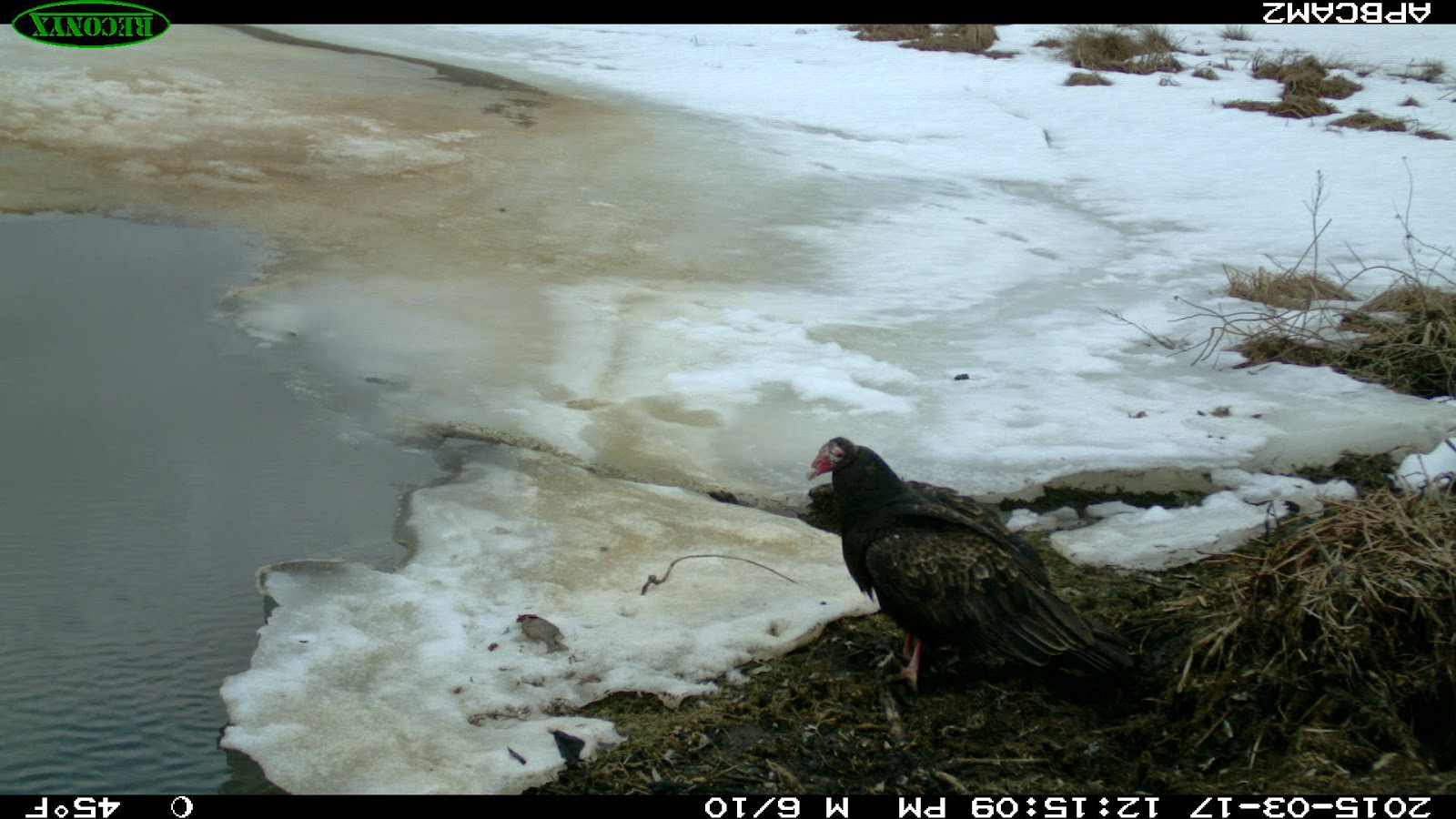
Fish that die from natural causes become food for a variety of animals. I wondered what sort of animals were rooting around the piles of small dead fish that accumulated near the outlet of the pond so I set up a trail camera that automatically takes photos of anything within its view that moves. Many crows have visited the fish sushi bar along with a single turkey vulture. I was hoping to see some mammals - but so far: none.
Two Crows Eating Fish

Turkey Vulture Snacking on Dead Sunfish

Monday, March 16, 2015

Tapping Sugar Maples, Attracting Deer, and Bubbling Fish

Gathering Maple Sap Exercise Program

This week warmed up enough for maple tree roots to pump sugary sap into trunks. It took quite a few days of above freezing weather to start the sap flowing because the ground has been covered by a few feet of snow and nighttime temperatures were, until recently, often in single digits. It takes less than five minutes to drill a hole, tap in a six-inch tube, slide on a gallon plastic jug and fasten it to the tube. We’ve found vinegar jugs the best but milk vessels also work. I drill an undersize hole into the upper hollow finger loop that each vessel has so the tube fits very snugly to prevent midges and mosquitoes from getting into the jug. We rarely have to screen the sap.
Gallon Milk Jugs as Maple Sap Collection Vessels
The sap level in the translucent jugs is readily visible from far away and when days don’t go much above freezing or stay there very long, it takes awhile for the tree to fill a jug. We have 14 taps going and, so far, only one tree fills its jug in 24 hours. The others barely produce a quart. To prevent losing any sap from the productive tree, I slipped a connector on the tube and ran a longer plastic tube into a five gallon covered pail. This morning I checked the line of trees and none dripped more than a pint of sap since last evening. So I went the quarter mile home without having to carry extra weight.
Gallon Vinegar Jug Collecting Maple Sap
It won’t be long when I’ll have to carry two full five-gallon pails (80 pounds) and sometimes even twice a day when the exercise program really kicks in. It’s all for a good cause: it takes 40 gallons of sap to make a gallon of maple syrup and our friends and family can readily consume four or five gallons over a year.

Recycling Nutrients

A long time ago we lived on a stream that salmon used for spawning. Many thousands swam upstream in late summer to mate, lay eggs and die. Our dog thought it a terrible waste to see thousands of fish rot along the edges of the stream so she rolled on them and ate as many as she could. She couldn’t digest them so had to throw them up, only to try again a bit later, or the next day. I’ve since read articles on how salmon benefit valleys where they spawn. The nutrients they carry from the deep ocean end up well distributed around the valley courtesy of the birds and mammals that eat live and dead salmon.

One afternoon we counted more than 40 eagles waiting to digest their last meal so they could eat again. None of the salmon lying along the stream had eyes because seagulls fought among each other to pick them out these delicacies: breaking through salmon skin was too much work! ….but not for eagles.
Deer Dropping Fertilizer
I think of them when I see deer and rabbit droppings all over the snow covering our fields. These herbivores cover wide ranges and deposit many droppings where they rest. It’s great to see a herd of deer spend hours in our grove of Douglas Fir and then later see pounds of droppings everywhere. Each year we use the top of one of these trees to celebrate winter holidays and the trunks and large branches for firewood. It’s great that the deer gather nutrients from miles around and the fertilize our fields and fir trees without me having to lift a finger!
Deer Droppings with Tracks Under Fir Trees

Thousands of Fish Die from Lack of Oxygen

Our neighbor has a 10+ acre pond that is very long. Every year we discuss placing a bubbling system in the deep end that would allow fish to survive the winter. Last winter fish older than two years died under the ice from lack of oxygen. We had a thaw in January, 2014, that opened up much of the ice and thoroughly oxygenated the pond that lasted long enough for the smaller fish to survive. The odor was pretty heavy for a few days in the spring but it didn’t take long for mammals and birds to gobble up the few hundred large bass and sunfish.

Large Pond Where Fish Died From Lack of Oxygen

This year the very deep snow on ice that formed in December and hasn’t yet melted. No January thaw.
Two+ Year-old Sunfish Died from Lack of Oxygen
The edges are melting in some places and reveal thousands of dead fish, including even last summer’ fry, see photos below. We’ll catch stock from our pond with enough pairs for them to repopulate this much larger pond. I hope this fall they invest in a bubbling system large enough to enable their whole pond of fish to thrive. Insects, mollusks, salamanders, frogs and turtles that also overwinter underwater should also benefit from well-oxygenated water. Some of them may die but won't be noticed since they bury themselves in the mud.
Summer's Young Fish Didn't Make it Through the Winter